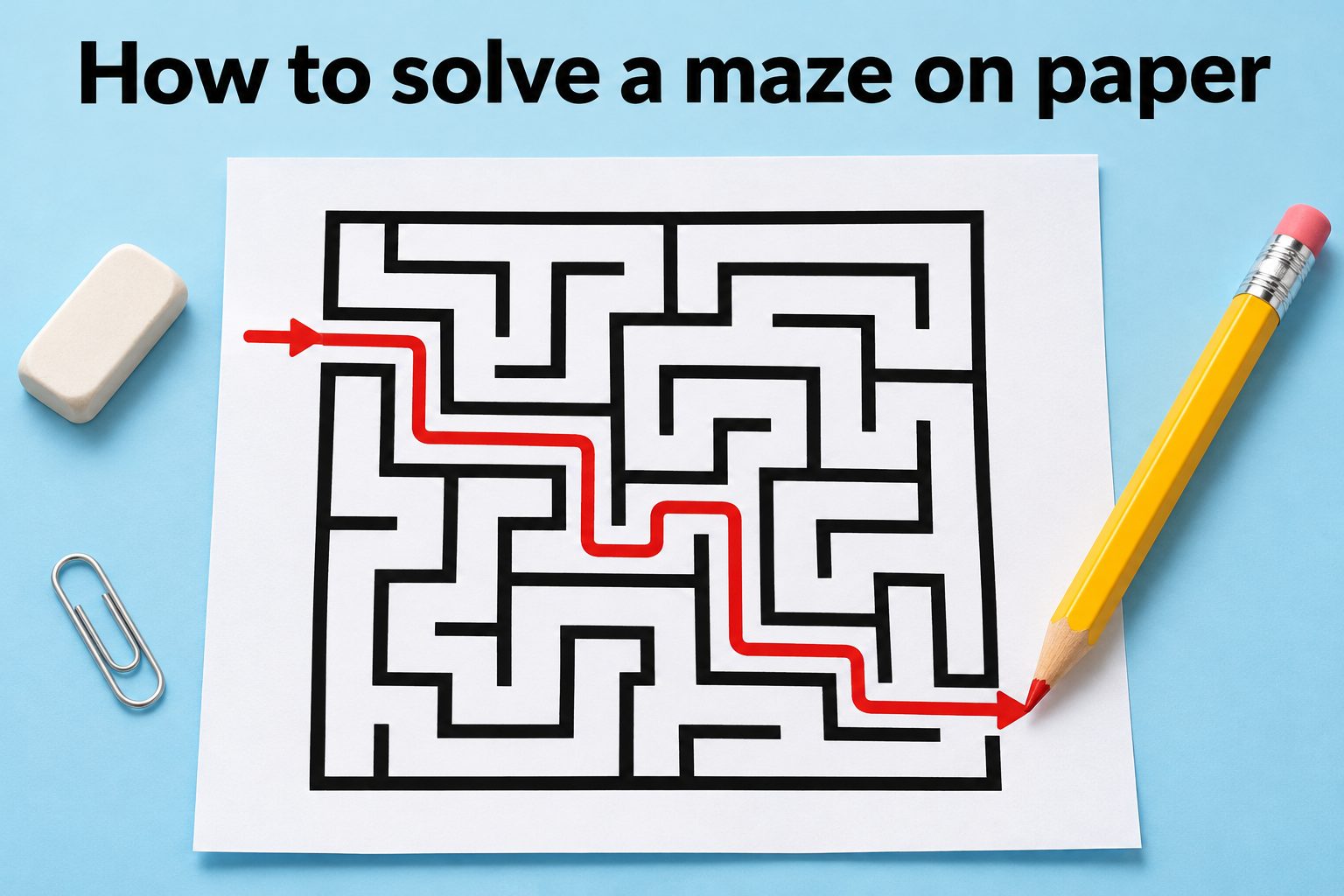
{"intro_paragraphs":["Learning how to solve a maze on paper is a simple skill that builds patience, focus, and practical problem-solving. Whether the maze appears in a puzzle book, classroom worksheet, newspaper, or activity sheet, the goal is the same: find a continuous route from the entrance to the exit without crossing walls.","A good maze can feel confusing because it offers many possible turns, dead ends, and loops. The secret is not to rush. Once you know how to scan the layout, track your choices, and back out of unhelpful paths, even a detailed paper maze becomes much easier to manage.","This guide explains reliable maze-solving methods, useful tools, common mistakes, and ways to practice. You will also learn when to use fast visual techniques and when a slower, more systematic approach will save time. By the end, you can approach paper mazes with a clear plan instead of guesswork."],"section_two_paragraphs":["A maze is a path puzzle made from passages separated by walls. It normally has one marked starting point and one destination, although some versions include multiple routes, misleading openings, or hidden rules that make the task more challenging.","Solving on paper matters because you can see the whole puzzle at once. That wider view helps you spot outer edges, long corridors, and repeated patterns before you commit to a route. It also lets you mark your work in a way that supports careful thinking.","Paper mazes are useful for children, adults, teachers, and anyone who wants a short mental break. They encourage visual attention without requiring screens, special equipment, or advanced mathematical knowledge.","The activity also teaches a valuable habit: a wrong turn is information, not failure. When a passage ends, you have ruled out one option and can return to the last decision point with more confidence.","Most maze-solving success comes from combining observation with a consistent method. You do not need to predict every turn at the beginning; you simply need a dependable way to make progress and correct yourself when necessary."],"section_three":{"h2":"How Can You Solve A Paper Maze Step By Step?","subsections":[{"h3":"1. Locate The Entrance And Exit","paragraph":"Begin by finding exactly where the maze starts and where it ends. Trace the border with your eyes because openings are sometimes placed close together or partially disguised by the design. Knowing both points gives you direction and prevents you from spending time exploring a route that cannot possibly lead to the goal."},{"h3":"2. Look Over The Entire Layout","paragraph":"Before drawing a line, scan the maze from top to bottom and notice obvious long corridors, narrow bottlenecks, and large open-looking sections. This quick survey gives you a mental map. You may notice that the exit sits near an outer wall or that several paths are separated by a single important junction."},{"h3":"3. Choose A Starting Method","paragraph":"Decide whether you will use a wall-following method, a backward trace from the exit, or a trial-and-backtrack approach. For a simple maze, choosing one wall to follow can work well. For a maze with many loops, marking explored branches and returning to junctions is usually more dependable."},{"h3":"4. Move One Junction At A Time","paragraph":"Treat every place where the path splits as a decision point. Follow one branch slowly until it reaches another choice, the exit, or a dead end. Avoid jumping your eyes across walls to guess several moves ahead, because this often causes you to lose track of the exact corridor you were following."},{"h3":"5. Mark Dead Ends Clearly","paragraph":"When a route stops, mark it lightly with a small line, dot, or short cross. A visible mark tells you not to repeat the same unsuccessful attempt later. Keep the mark subtle enough that you can still see the maze walls and any nearby open passages clearly."},{"h3":"6. Backtrack To The Last Choice","paragraph":"After reaching a dead end, return along the same path to the most recent junction where another route was available. Do not restart from the entrance unless you have lost your markings. Backtracking is the core of systematic maze solving because each failed branch narrows the remaining possibilities."},{"h3":"7. Verify The Finished Route","paragraph":"Once your line reaches the exit, inspect it from beginning to end. Check that it stays inside the passages, does not cross a wall, and does not accidentally use a gap that is closed. A quick final review turns a nearly correct answer into a clean, reliable solution."}]},"section_four":{"h2":"Why Does Solving A Maze On Paper Help?","points":["Improves visual focus by asking you to distinguish open corridors from walls and decorative lines.","Builds patience because progress often depends on careful checking rather than quick guessing.","Strengthens planning skills as you compare routes, notice junctions, and decide where to explore first.","Encourages flexible thinking by showing that a dead end can guide your next better decision.","Supports fine motor control when you trace routes neatly with a pencil or pen."],"section_five":{"h2":"Useful Tools For Paper Maze Solving","bullets":[{"label":"Pencil","text":"A pencil is the best default tool because you can erase an incorrect route without damaging the page. Use a sharp point for dense mazes where corridors run close together."},{"label":"Eraser","text":"A clean eraser helps you remove wrong turns while keeping the maze readable. Erase gently so you do not blur thin printed walls or tear lightweight puzzle paper."},{"label":"Highlighter","text":"A light-colored highlighter can separate the final route from exploratory marks. It works best after you have already confirmed the correct path in pencil."},{"label":"Finger Guide","text":"Using a fingertip before drawing helps you test a route without making permanent marks. This is especially useful when the maze is large or when you want to avoid clutter."},{"label":"Ruler","text":"A ruler is optional, but it can help trace long straight passages neatly. Do not rely on it for every turn, since stopping to reposition it may interrupt your concentration."},{"label":"Scratch Paper","text":"A small piece of scratch paper can cover completed areas or hold notes about repeated junctions. It is useful for advanced mazes that contain several similar-looking branches."}]},"section_six":{"h2":"Common Paper Maze Mistakes To Avoid","subsections":[{"h3":"1. Drawing Too Quickly","paragraph":"Rushing is the most common reason people cross a wall or enter the wrong corridor. Slow down at corners and junctions, especially when the printed lines are thin. A steady pace is usually faster overall because it prevents the repeated erasing and retracing caused by careless mistakes."},{"h3":"2. Using Pen Too Early","paragraph":"Ink can make a paper maze frustrating when you discover a wrong turn. Start with pencil unless the puzzle is extremely easy or you are tracing only after solving visually. If you prefer pen, first test each route with your finger and commit only after checking the next few turns."},{"h3":"3. Forgetting To Mark Failed Paths","paragraph":"Without a small mark at dead ends, you may keep returning to the same unproductive route. This wastes time and makes the maze feel harder than it is. Use one consistent symbol for rejected branches so your earlier work remains useful as you explore the remaining options."},{"h3":"4. Ignoring The Exit","paragraph":"Many solvers stare only at the entrance and start immediately. Looking at the exit first can reveal a narrow final corridor or a limited number of possible approaches. In some puzzles, tracing backward from the exit is easier because there are fewer tempting branches near that end."},{"h3":"5. Following A Wall In Every Maze","paragraph":"Keeping one hand on a wall is a helpful technique, but it does not solve every maze efficiently. In mazes with islands, loops, or disconnected wall structures, wall-following can lead you around long circles. Be ready to switch to marking and backtracking when the layout calls for it."},{"h3":"6. Losing Your Place At Junctions","paragraph":"A busy maze can make several nearby openings look alike. When you reach a junction, pause and identify the exact branch you are leaving and the branch you plan to test. Lightly marking the junction or retracing a short distance can prevent confusion after a dead end."},{"h3":"7. Treating A Dead End As Failure","paragraph":"A dead end is useful evidence that one route cannot work. If you react by restarting in frustration, you ignore information you already earned. Instead, return calmly to the last unexplored choice and continue. This mindset makes difficult maze puzzles feel like organized searches rather than random traps."}]},"conclusion_paragraphs":["Solving a maze on paper becomes much easier when you begin with a quick survey, move carefully through each junction, and mark routes that do not work. A pencil, an eraser, and a consistent method are usually all you need.","The best approach depends on the puzzle. Wall-following can be fast for simple layouts, while backtracking and clear markings are safer for dense or looping mazes. Looking from the exit backward can also reveal useful clues.","Most importantly, stay patient. Each wrong branch removes uncertainty, and each careful decision brings you closer to the exit. With practice, you will read maze patterns more quickly and solve them with less hesitation."],"faq":{"h2":"FAQs About Solving A Paper Maze","items":[{"question":"1. What Is The Easiest Way To Solve A Paper Maze?","answer":"For a simple maze, follow either the left or right wall continuously from the entrance until you reach the exit. If the maze contains loops or isolated sections, use a pencil to mark dead ends and backtrack to the last junction. This systematic approach is more reliable than guessing."},{"question":"2. Should I Start From The Entrance Or The Exit?","answer":"Either direction can work. Start from the exit when its surrounding passages look simpler or when the entrance immediately offers many choices. Starting from the entrance is natural for most people, but tracing backward from the goal can reduce confusion in a maze with a crowded beginning."},{"question":"3. Can Every Maze Be Solved By Following One Wall?","answer":"No. Wall-following works best when the maze is connected in a way that links the chosen wall to the entrance and exit. Some maze designs contain loops or separate wall islands that can keep you circling. In those cases, mark explored paths and use backtracking instead."},{"question":"4. How Do I Avoid Crossing A Maze Wall?","answer":"Use a sharp pencil and trace slowly, particularly at tight corners. Keep your eyes slightly ahead of the pencil tip so you can see the next turn before committing. If the printing is faint, test the path with your finger first and draw the final line only afterward."},{"question":"5. What Should I Do When I Reach A Dead End?","answer":"Do not erase the entire attempt or restart automatically. Mark the dead end, then follow your route backward to the latest junction that has an untried branch. Choose that new branch and continue. This process preserves your progress and ensures you do not repeat known failures."},{"question":"6. Are Paper Mazes Good For Children And Adults?","answer":"Yes. Children can practice pencil control, visual attention, and persistence with age-appropriate mazes. Adults can use them as a relaxing screen-free puzzle that still engages planning and concentration. The challenge can be adjusted easily by changing maze size, corridor width, and the number of misleading branches."}]}}
How to Solve a Maze on Paper: Step-by-Step Guide