
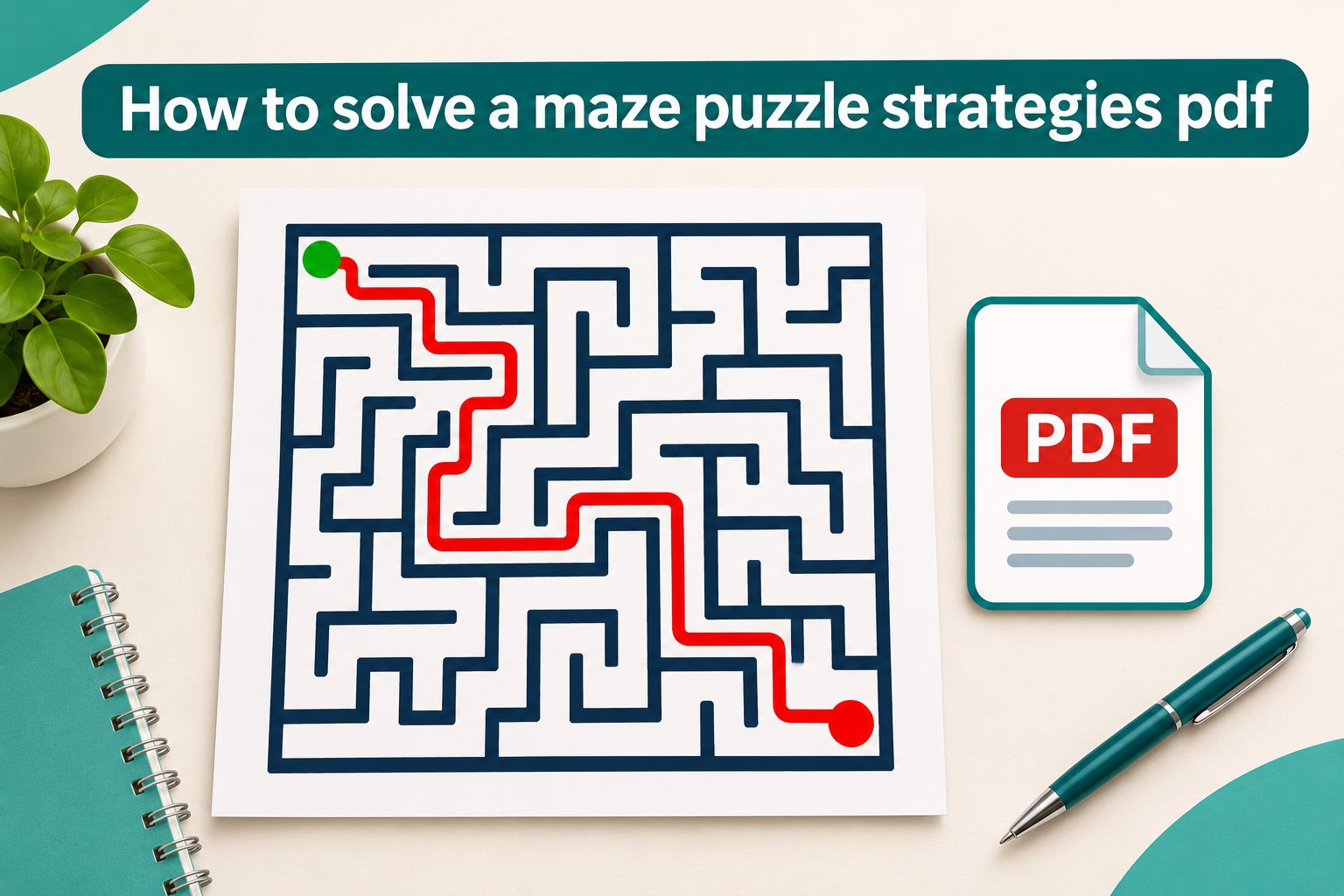
Learning how to solve a maze puzzle strategies pdf can make printable mazes feel less frustrating and far more rewarding. A maze is a pathfinding puzzle with a clear start, an exit, and several wrong turns. The goal is simple, but the best solution often depends on patience, observation, and a method that suits the maze design.
Maze puzzles build useful skills beyond entertainment. They encourage visual focus, planning, memory, and calm decision-making. Children can use them to practice pencil control and problem solving, while adults can use them as a relaxing mental exercise or a quick way to reset attention during a busy day.
This guide explains practical maze-solving methods, how to choose the right strategy, common mistakes to avoid, and ways to use a printable PDF effectively. Whether the puzzle is easy, complex, hand-drawn, or designed for a classroom, the same core habits can help you find the route with more confidence.
A maze is easier to solve when you treat it as a map instead of a test of speed. Before drawing a line, look for the entrance, the finish, long corridors, enclosed areas, and sections with many branches. This brief scan gives your brain a useful overview of the puzzle.
Most printed maze worksheets include one valid route, but some use loops, misleading open spaces, or several paths that almost reach the exit. These design features are meant to slow down rushed solving, not to make the puzzle impossible. A steady method is more valuable than guessing.
Using a pencil is usually the most practical choice for a maze puzzle PDF. You can lightly mark explored paths, erase dead ends, and keep the final route readable. If you use a digital PDF viewer, a simple annotation tool can serve the same purpose.
The difficulty of a maze is not only about its size. A small maze with tight turns and many false passages can be harder than a large maze with clear corridors. Notice how often paths split and reconnect, because those details affect which strategy will work best.
Good maze solvers also know when to pause. If you repeatedly return to the same area or feel unsure about your last choice, stop tracing and look at the entire puzzle again. A short reset often reveals a route or barrier that was easy to miss.
How Do You Solve A Maze Puzzle?
Start With A Full Visual Scan
Locate the start and finish before committing to a route. Then scan the outside edges and the largest open corridors for obvious connections. This first look reduces random movement and helps you notice whether the exit is close to a border, hidden behind a loop, or reachable only through the center.
Choose A Direction To Trace
Pick either the entrance or the exit as your starting point and trace carefully from there. Working backward from the finish can be especially useful when the exit has only one narrow approach. Choose one direction and stay consistent until you have a reason to switch.
Mark Dead Ends Lightly
When a corridor ends without reaching the goal, mark it with a small pencil line or a subtle symbol. This prevents you from solving the same dead end twice. Light marks preserve a clean worksheet and make it easy to erase your working notes when you finish.
Use The Wall-Following Method
For many connected mazes, place your imaginary hand on either the left or right wall and keep following that same wall. This method can guide you through simple maze layouts without skipping branches. It is less reliable in mazes with isolated loops, so remain alert for repeated circuits.
Work Backward From The Exit
Reverse solving is useful when the start has many early choices but the exit has only one or two possible approaches. Trace backward and eliminate routes that cannot connect to the entrance. Meeting your forward route from the other direction provides a strong check that the solution is correct.
Break The Maze Into Small Zones
Divide a large maze mentally into top, middle, bottom, left, and right areas, or use visible landmarks such as corners and long hallways. Solve one zone at a time instead of trying to hold the whole route in memory. This makes a dense printable maze feel more manageable.
Review The Finished Route
After reaching the exit, follow your completed line once more from start to finish. Check that it never crosses a wall, jumps between corridors, or leaves an unexplored gap. A quick review catches small tracing errors and gives you confidence before sharing or printing the completed puzzle.
Which Maze Strategy Fits Your Puzzle?
1. The left-hand rule works well for straightforward mazes with connected outer walls, but it may keep you circling in mazes that contain separate loops.
2. The right-hand rule follows the same principle from the opposite side. Try it when the entrance begins beside a right-side wall or when that direction offers a clearer initial corridor.
3. Backward tracing is effective when the exit is easier to inspect than the entrance. It cuts down the number of early branches you need to test.
4. Dead-end filling is ideal for complex printed mazes. Cross out every obvious dead end, then continue removing new dead ends until the remaining route becomes visible.
5. A center-out approach can help with symmetrical mazes where the middle has a recognizable hub. It is best used with careful marking so that nearby branches do not blend together.
6. Visual scanning without drawing is useful for short, easy mazes. It trains observation, but it becomes less dependable as intersections and loops increase.
7. Digital annotation is helpful when a maze PDF is reused by several learners. Each person can use a different color or copy of the document without changing the original printable file.
Benefits Of Maze Puzzle Practice
- Improved Concentration: Following narrow paths asks the solver to focus on small visual details for a sustained period. Regular practice can make it easier to ignore distractions and return attention to one task.
- Stronger Planning Skills: A maze rewards looking ahead before moving. Solvers learn to compare options, predict obstacles, and revise a plan when a chosen route fails.
- Better Fine Motor Control: Tracing a path with a pencil supports controlled hand movement. This is especially useful for young learners who are developing writing and drawing skills.
- Calmer Problem Solving: A maze provides a low-pressure way to practice recovering from mistakes. Erasing a wrong path teaches that changing direction is a normal part of solving.
- Visual Reasoning Practice: Mazes require the brain to recognize barriers, openings, turns, and spatial relationships. Those skills support many activities that involve maps, diagrams, and patterns.
- Flexible Learning Activity: A maze puzzle PDF can be printed for independent practice, added to a lesson, used during travel, or completed digitally. The format makes it easy to match puzzles to different ages and ability levels.
What Maze Mistakes Should You Avoid?
Rushing Into The First Opening
The first available corridor is not always the best route. Starting immediately without a scan often creates extra backtracking and confusion. Take a few seconds to study the maze shape, especially the entrance area, so that your first move is informed rather than automatic.
Changing Methods Too Often
Switching from wall-following to random guessing and then to backward tracing can make your marks hard to read. Choose one strategy long enough to test it properly. If it is not working, pause, erase the uncertain section, and deliberately move to a different method.
Making Heavy Permanent Marks
Dark pen lines can hide narrow gaps, create visual clutter, and make corrections difficult. Use a sharp pencil or a light digital annotation line while solving. Save bold coloring or final outlining for after you have checked that the route reaches the exit correctly.
Ignoring Repeated Loops
If you reach the same intersection from the same direction more than once, you may be trapped in a loop. Treat that repetition as information, not failure. Mark the route, backtrack to the last untested branch, and try the remaining option instead of repeating the cycle.
Forgetting To Check Wall Boundaries
A line can look correct at a quick glance while crossing a wall at a tight corner. Move slowly through narrow sections and review every turn after solving. Accuracy matters more than speed, particularly on mazes with thin lines or crowded pathways.
Trying To Memorize Everything
Holding every explored branch in your head works only on simple puzzles. On a larger maze, memory becomes unreliable and causes repeated work. Use small marks to record dead ends, tested paths, and uncertain intersections so your visual record supports your reasoning.
Treating Every Maze The Same
Different designs reward different approaches. A simple border maze may suit wall-following, while a branching puzzle may be faster with dead-end filling. Look at the number of loops, the location of the exit, and the density of corridors before choosing your strategy.
Solving a maze becomes much easier when you begin with observation, use a consistent method, and make light notes as you work. Scanning the layout, tracing from the start or exit, and marking dead ends all reduce wasted movement.
The most useful strategy depends on the maze itself. Wall-following can guide you through simple connected layouts, while backward tracing and dead-end filling are often better for puzzles with many branches or loops.
A maze puzzle PDF is also a practical tool for building focus, visual reasoning, patience, and controlled movement. Use a pencil, work in small areas, and review the final path to turn each puzzle into a clear and satisfying problem-solving exercise.
FAQs About Maze Puzzle Strategies
What Is The Easiest Way To Solve A Maze?
For a simple maze, start by scanning the full layout and then use the left-hand or right-hand wall-following method. Keep your chosen hand against one wall as you trace. If you enter a repeated loop, stop, mark it, and return to the last unexplored branch.
Should I Start At The Entrance Or The Exit?
Either direction can work, but begin at the side with fewer obvious choices. Starting from the exit is often faster when it has one narrow approach, while starting at the entrance may feel more natural on easy worksheets. You can also trace from both ends until the routes meet.
Does The Left-Hand Rule Always Work?
The left-hand rule works well when the maze walls form one connected structure and the start is connected to the outer boundary. It may fail or take a long time in mazes with isolated loops or separate wall sections. Use it as a practical tool, not an absolute rule.
How Can Children Solve Mazes More Easily?
Give children a pencil with an eraser, begin with age-appropriate maze sizes, and encourage them to scan before tracing. Teach them to mark dead ends rather than feeling discouraged by them. Short sessions and clear visual cues help build confidence without making the activity feel like a test.
Can I Solve A Maze PDF Without Printing It?
Yes. Open the PDF in a viewer that supports drawing or annotation, then use a thin line and a light color while you explore. Keeping the original file unchanged is helpful when you want to retry the maze, share it with another person, or use different strategies.
Why Do I Keep Getting Lost In Mazes?
Getting lost usually happens when you rely on memory alone, trace too quickly, or revisit the same branches without marking them. Slow down at intersections and use small notes for dead ends and uncertain choices. Breaking the puzzle into zones also prevents the overall layout from becoming overwhelming.