
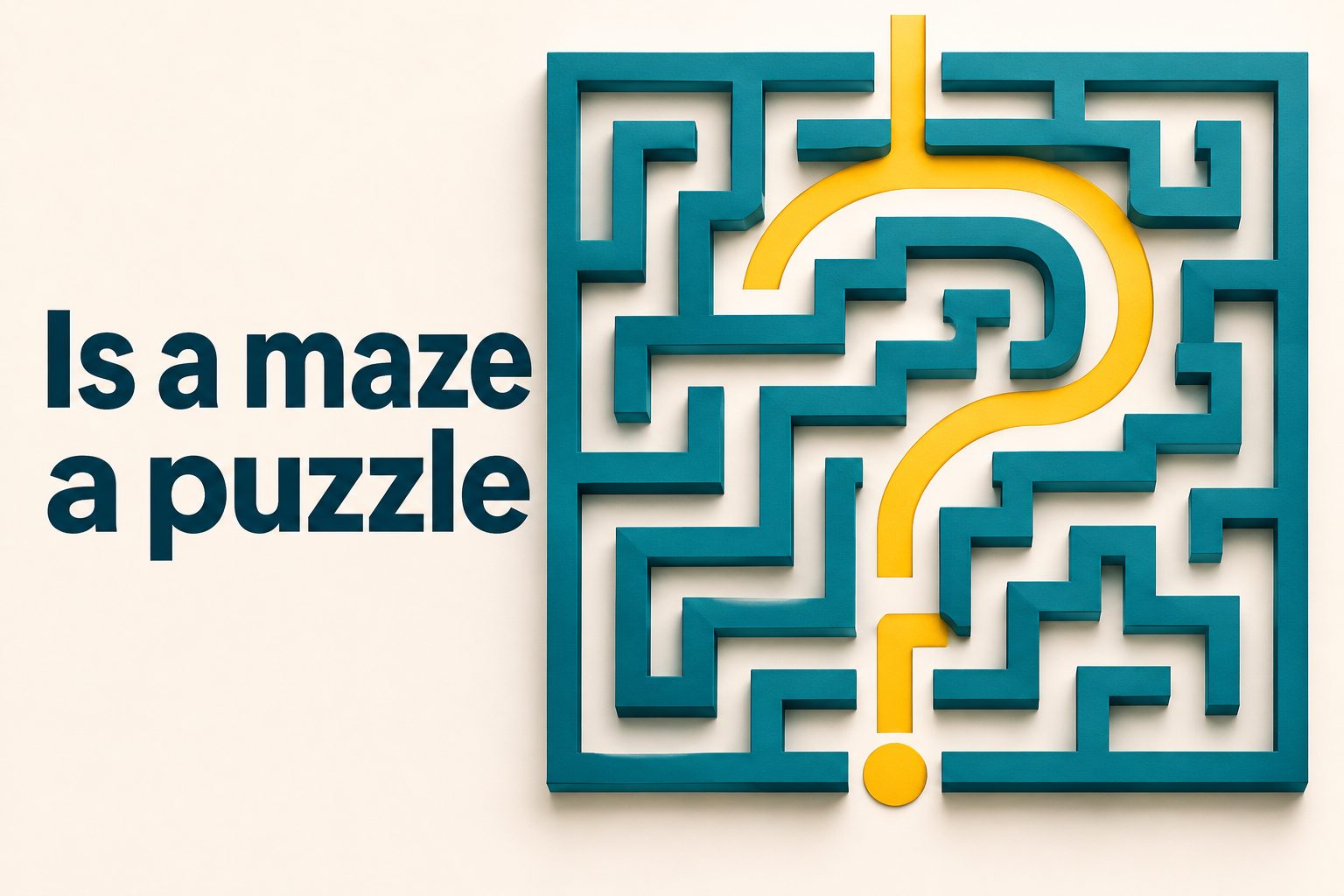
Is a maze a puzzle? In most everyday situations, the answer is yes. A maze gives a person a goal, a set of paths, and a challenge that must be solved through choices, observation, or trial and error. It asks the solver to find a route from an entrance to an exit, often while avoiding dead ends.
Still, the terms maze and puzzle are not identical. A puzzle is a broad category that can involve words, numbers, objects, logic, patterns, or physical movement. A maze is a particular kind of spatial puzzle, although some mazes are designed more as decorations, games, or walking experiences than difficult mental tests.
Knowing the difference helps parents, teachers, game designers, and curious solvers choose the right activity. This article explains what makes a maze a puzzle, how mazes work, why they are useful, and how to approach them thoughtfully.
A maze is a network of routes in which a person must navigate from one point to another. The routes may be drawn on paper, built from hedges, printed in a book, created in a digital game, or laid out with objects on the floor. The central task is finding a valid path.
A puzzle is any challenge that requires thought, skill, or strategy to reach a solution. Some puzzles have one correct answer, while others invite several approaches. Crosswords, jigsaws, riddles, and logic grids all fit under this broad description.
Most mazes qualify as puzzles because they present a problem with constraints. The solver cannot travel straight to the goal and must evaluate turns, notice repeated patterns, remember explored routes, and adjust when a route fails.
The difficulty of a maze can range from very simple to highly complex. A preschool maze may only require following a curved line, while a large labyrinth-style game may involve maps, decisions, time pressure, hidden clues, and teamwork.
The important distinction is purpose. If the layout is intended to challenge navigation or problem-solving, it functions as a puzzle. If it is only a decorative winding path with no choices or wrong turns, it may be better described as a path or labyrinth than a traditional maze.
Why Is a Maze Considered a Puzzle?
1. It Presents a Clear Problem
A typical maze gives the solver a specific problem: reach the finish from the starting point. That simple goal creates a puzzle structure because the person must work within boundaries rather than move freely. Walls, lines, gates, or obstacles define what is allowed and prevent an immediate answer.
2. It Requires Meaningful Choices
At each intersection, a maze asks the solver to choose between possible routes. Some choices lead forward, while others lead to loops or dead ends. This decision-making element is one reason a maze is a puzzle: progress depends on evaluating options instead of simply following instructions.
3. It Uses Spatial Reasoning
Solving a maze relies on spatial reasoning, which is the ability to picture positions, directions, distance, and relationships between objects. A solver may mentally rotate the layout, compare nearby corridors, or notice where two paths seem likely to connect. These are genuine problem-solving skills.
4. It Includes Constraints
Good puzzles need limits, and a maze has obvious constraints. A player generally cannot cross walls, skip to the exit, or ignore the route system. These limits make the answer satisfying because success comes from navigating the available structure rather than taking an unrestricted shortcut.
5. It Can Reward Strategy
Although luck can help in a small maze, strategy becomes more important as complexity increases. A person may trace a wall, mark rejected paths, work backward from the exit, or look for patterns in the design. The ability to use a repeatable method gives mazes the character of a puzzle.
6. It Offers Feedback During Play
A maze provides immediate feedback. A dead end shows that a choice did not work, while an open corridor suggests possible progress. This feedback loop encourages testing, learning, and revising decisions. Like many puzzles, the maze teaches through the consequences of each move.
7. It Has a Solvable Outcome
Most traditional mazes are designed with at least one route that reaches the goal. The solver knows that a solution exists, even if it is not obvious. That expectation of a discoverable answer separates a maze from random wandering and places it firmly within the puzzle family.
How Do Mazes Differ From Labyrinths?
1. A maze usually contains branches, wrong turns, and dead ends, so the participant must make choices to find the exit. A labyrinth traditionally has one winding route to the center or destination, making the experience more about following a path than solving alternatives.
2. A maze is commonly competitive or problem-focused. It may be timed, scored, or designed to test attention. A labyrinth is often used for reflection, walking meditation, ceremony, or visual beauty, although modern usage sometimes blends the two terms.
3. Paper mazes are usually puzzles because the solver must identify a correct route. A single-path labyrinth printed on paper can still be enjoyable, but it normally offers less logical challenge because there are no choices to compare.
4. A hedge maze can become a physical puzzle when visitors cannot see the full layout and must navigate intersections. A labyrinth made from stones or painted lines is usually easier to follow because its path is visible and unbranched.
5. The words are often used casually, so context matters more than strict terminology. Calling a complex garden attraction a maze is understandable, but recognizing the structural difference helps explain whether it truly operates as a puzzle.
What Benefits Do Maze Puzzles Offer?
- Focus And Patience: A maze encourages sustained attention because the solver must notice details and resist rushing into every available path. Working through a wrong turn can also build patience and a calmer response to small setbacks.
- Problem-Solving Practice: Each intersection creates a small decision. Solvers learn to compare options, test ideas, and revise a plan when the evidence changes. Those habits are useful far beyond puzzle books.
- Fine Motor Development: For young children, tracing a paper maze with a pencil supports hand control, visual tracking, and coordination. Reaching the exit gives a concrete reason to practice careful, controlled movement.
- Spatial Awareness: Mazes help people recognize direction, distance, boundaries, and route relationships. This can strengthen the ability to read simple maps, organize visual information, and imagine movement through a space.
- Memory Skills: More difficult mazes ask solvers to remember which corridors have already been explored. Keeping track of failed routes prevents repeated work and exercises working memory in an engaging way.
- Enjoyable Challenge: A well-matched maze offers a clear goal without requiring specialized knowledge. It can provide a short break from routine while giving the satisfying feeling of making visible progress toward a solution.
How Can You Solve a Maze Effectively?
1. Look Over the Whole Layout First
Before drawing a line or taking a step, scan the entrance, exit, major intersections, and unusually open areas. A quick overview can reveal likely bottlenecks or broad routes. It also prevents the common mistake of committing to the first visible corridor without considering the layout.
2. Choose a Consistent Method
For many connected mazes, following one wall continuously can eventually lead to the exit. Keep one hand on the left or right boundary and do not switch casually. This method is not perfect for every maze, but consistency makes it easier to avoid random, repeated decisions.
3. Mark Dead Ends Clearly
On a paper maze, lightly mark routes that have already failed. In a physical maze, remember a landmark or agree on a simple team signal. Recording dead ends reduces backtracking and turns a confusing layout into a gradually smaller problem.
4. Work Backward When Helpful
Starting from the exit can make difficult mazes easier to analyze. Trace backward through passages that appear promising, especially when the ending is surrounded by many short dead ends. Meeting a route from both directions often exposes the correct connection more quickly.
5. Break the Maze Into Smaller Areas
Do not treat a large maze as one overwhelming image. Focus on reaching the next junction, corner, or recognizable region. Solving local sections one at a time reduces mental load and creates manageable milestones while preserving a sense of forward movement.
6. Pause Before Repeating a Route
If you find yourself revisiting the same place, stop and check what information is missing. You may have overlooked a branch, forgotten a mark, or changed your method. A brief pause is usually more productive than moving faster through familiar corridors.
7. Match the Challenge to the Solver
The best maze is difficult enough to require thought but not so hard that it becomes frustrating. Children may benefit from wide paths and obvious landmarks, while experienced solvers may enjoy loops, misleading routes, or additional rules such as time limits.
A maze is generally a puzzle because it gives the solver a goal, rules, choices, obstacles, and a route that must be discovered. Its challenge comes from navigation, observation, memory, and strategy rather than from words or numbers.
Not every winding path is a maze in the strict sense. A single-route labyrinth may be designed for calm movement or reflection, while a branching maze creates the decisions and dead ends associated with puzzle-solving.
Whether it appears in a workbook, a video game, a classroom activity, or a garden, a maze can be both entertaining and useful. The best approach is to view it as a solvable problem, work methodically, and enjoy the small discoveries along the way.
FAQs About Is a Maze a Puzzle
Is every maze a puzzle?
Most mazes are puzzles because they require a person to find a route through choices and obstacles. However, a very simple decorative path or a single-route labyrinth may not offer enough decisions to feel like a puzzle. The intended purpose and layout determine the best description.
What is the main difference between a maze and a puzzle?
A maze is a specific type of puzzle focused on navigation through a layout. A puzzle is a much broader term that includes word games, logic challenges, jigsaws, riddles, and physical tasks. In other words, many mazes are puzzles, but most puzzles are not mazes.
Can a labyrinth be called a maze?
In casual conversation, people often use maze and labyrinth interchangeably. More precisely, a maze has branches and choices, while a traditional labyrinth follows one continuous route. A labyrinth can still be enjoyable and meaningful, but it generally involves less route-finding than a maze puzzle.
Are mazes good for children?
Yes, age-appropriate mazes can help children practice visual tracking, pencil control, patience, and simple planning. They also provide a safe way to experience mistakes and try another option. Choose clear designs with a difficulty level that creates interest without causing unnecessary frustration.
What skills do maze puzzles develop?
Maze puzzles can support spatial reasoning, attention, working memory, fine motor control, and strategic thinking. They also encourage persistence because a wrong turn is not a final failure; it is information that helps the solver make a better choice on the next attempt.
Is there always one correct way through a maze?
No. Some mazes have a single solution, while others include several valid routes from entrance to exit. Designers may also add rules, such as collecting items or avoiding marked areas, that make one route preferable. The key requirement is usually reaching the goal within the maze’s constraints.